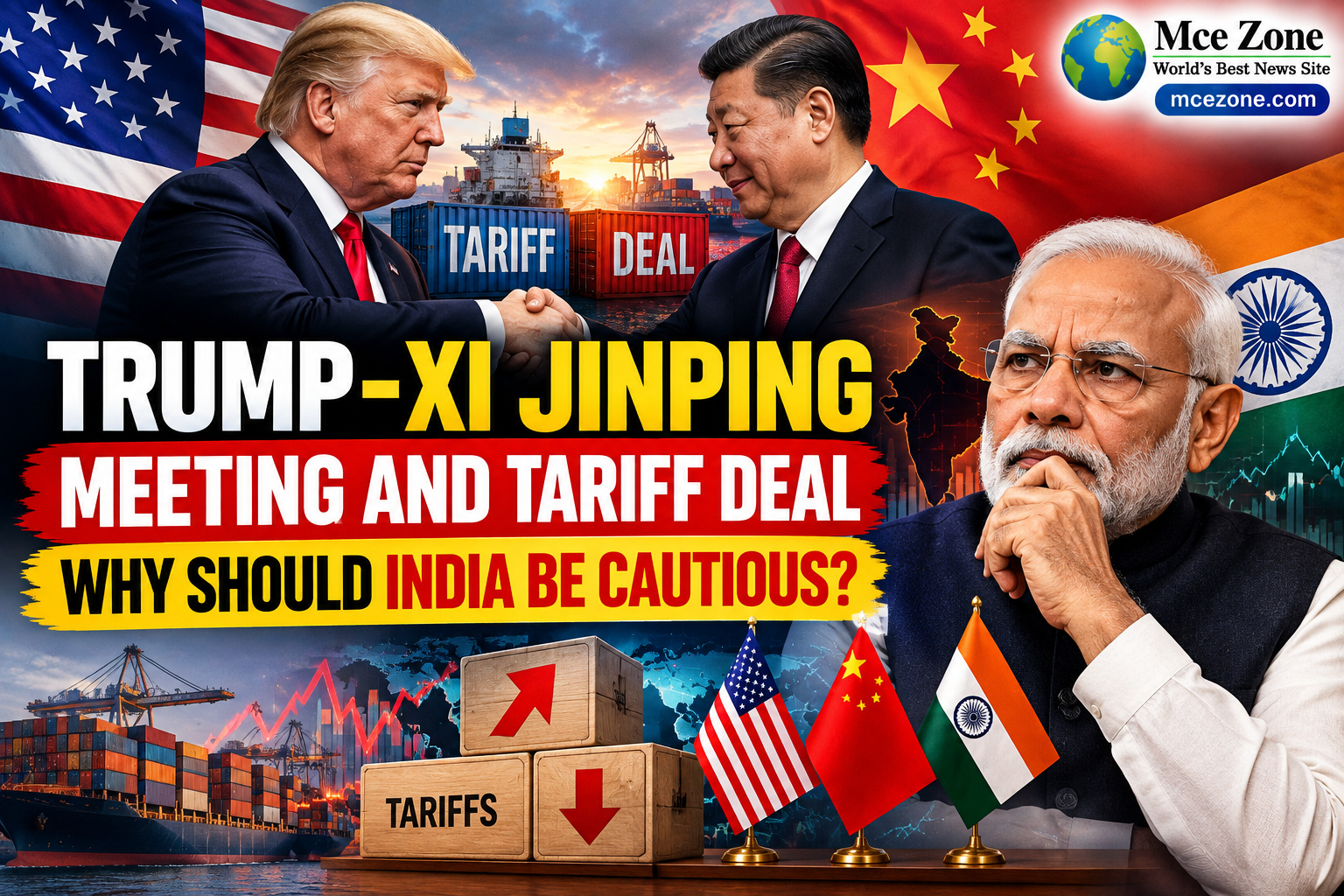

Trump-Jinping Meeting and Tariff Deal
US-China Trade Agreement: Both China and the United States have mutually agreed to reduce tariffs on imported goods worth $30 billion (approximately ₹2.5 lakh crore), and China’s Ministry of Commerce has now announced the implementation of this decision.
Tensions between the US and China in the trade sector have been evident for the past few years. However, reports indicate that the two nations have quietly reached an agreement on several issues. According to China’s Ministry of Commerce (MOFCOM), both countries reduced tariffs on imports worth $30 billion on September 28.
In fact, the bilateral summit between Donald Trump and Xi Jinping has marked a turning point in global geopolitics and economic balance. An eight-point consensus was reached during this three-day summit held in Washington.
Both China and the US have mutually agreed to reduce tariffs on imported goods worth $30 billion (approximately ₹2.5 lakh crore), and China’s Ministry of Commerce has now announced the implementation of this decision.
Impact of the US-China Tariff Reduction
The US will gain relief from Chinese tariffs on American products such as agricultural goods, seafood, and medical equipment. In return, the US has agreed to lower tariffs on Chinese toys and household appliances.
Washington and Beijing have extended the term of their existing trade agreement (the Busan Agreement) until January 10, 2027. Additionally, the two countries have agreed to launch the “US-China Super Intelligence (SI) Dialogue.”
What Will Be the Impact on India?
Until now, India has strategically benefited from the US-China tensions. An improvement in relations between these two superpowers could increase pressure on India to meet US demands regarding trade and defense. Reducing tariffs on Chinese toys, electronics, and consumer goods in the US market would lower their prices. Consequently, competition for Indian engineering and consumer goods in the US market could intensify. As trade tensions between the US and China ease, the trend of global companies shifting manufacturing from China to India might slow down.
Does this signal a crisis for India?
This trade truce between the US and China is certainly creating indirect strategic and economic pressure on India. While the two nations have agreed to discuss artificial intelligence (AI) and advanced technologies, they have not established direct lines of communication.
The risk is that these two superpowers could jointly set AI frameworks and global standards, potentially marginalizing emerging technology hubs like India. If the US focuses on transactional deals with China rather than maintaining a balance of power, it could impact India’s pivotal role in the Indo-Pacific region.
Were these agreements imposed?
Although the two nations are geopolitical rivals, they have reached a pragmatic understanding through Washington-led talks, driven by their respective domestic imperatives. The US needs to curb inflation and secure supply chains for critical resources like rare earth minerals. Meanwhile, China is looking to the US market to revitalize its sluggish exports.
Both nations have adopted an unwritten policy: they avoid harming each other while acknowledging each other’s limitations regarding complex issues such as the Iran crisis, the global energy crisis, and—crucially—the Strait of Hormuz.
The most important lesson for India is that in international relations, there are no permanent friends or enemies—only permanent interests. If the US and China reach a strategic understanding regarding Taiwan or the South China Sea, it could further embolden China in the Indian Ocean region.
Could this also be a positive sign for India?
Every coin has a flip side. The easing of US-China tensions holds some positive aspects for India as well. An end to the trade war between the US and China could reduce the risks of a global recession and energy crisis, which would benefit the Indian economy.
Improved relations between the US and China do not pose an existential crisis for India; rather, they simply necessitate a cautious approach. India must recognize that the US can partner with any nation to advance its own economic priorities.
Therefore, India needs to strengthen its domestic manufacturing (such as through the PLI scheme), achieve self-reliance in defense production, and solidify its position in global supply chains to such an extent that neither superpower can afford to disregard India’s interests.
Read more articles on mcezone.com